Jerusalem Film Festival 2006 and Ramallah, part 2
by Ludmila Cvikova
Walls and checkpoints 
It all started as a coincidence, and it had a strange taste of a conspiracy. During one of my last hotel breakfasts I came across another juror, Catherine Le Clef, who started to tell me about a film maker from Palestine:
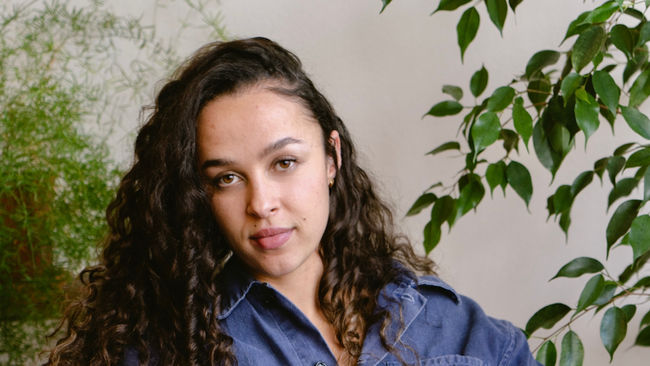
Buthina Canaan Khoury (picture).
She has known her for a long time now and wanted to visit her, once having been so close. All of a sudden I was reminded of another film maker living in Ramallah, whom we met in Cairo, Egypt, three years ago –
Ismael Habbash. One thing led to another and off we went, in a car heading for the Calandia checkpoint. There Buthina would be waiting for us to take us to Ramallah. Meeting Buthina was another surprise. Instead of an Arab woman with a head-scarf, I met a self-assured Christian Arab woman driving one of the biggest BMW I ever saw. Buthina is a film maker and a fighter. She has established Majd Production Co. in Ramallah and makes films on vital Palestinian issues. And Buthina is a perfect host – in the brief time she found for us, she drove us around and took us to one of the famous restaurants (where everyone knows her as they sell her family beer there, the oldest Palestinian one, and very tasty indeed).
Coming back from the West Bank we had to join a group of tired looking Palestinians and pass the checkpoint. The quere did not seem to move at all and in the end that got on some men’s nerves, even though it seemed to me they knew no other life. It was a real deja-vu for me – only this time it all went easier than in other places, years ago. Once on the other side, we joined a group of chatty Palestinians and we merrily took a small, no. 72 bus together with them heading back to Jerusalem. It was only during my second visit to Ramallah that I manage to meet Ismael Habbash,
Mustafa Abu Ali and other film makers too, during their regular Monday afternoon meeting when I explained to them how our festival’s Hubert Bals Funds works and how they could apply for it.
Making Business 
I do not intent to spend all day at the first
Jerusalem Pitch Point (picture)organised by the festival but I couldn’t leave it unnoticed and sneaked in to see and hear the presentation of a few projects. That’s also where I come across my old colleague Ido Abram and Fortissimo’s Wouter Barendrecht and Nelleke Driessen. Of course, where else? It’s all business here. Fortissimo invited me to dinner later that evening, where I was able to meet other people from the film industry. Business is a part of film making and as a director you’d better be nice to people who have money. They understand that at the Lab Theatre. I stayed and saw three presentations and one of them I even think would be interesting for our Cinemart. It’s a very personal story of a Polish boy growing up in the 1950s and turning into an anti-Semite. When his single mother finds out, she decides to move to Israel. And to avoid unnecessary and dangerous hostility, she spreads a rumour they are emigrating to Australia. The boy only finds out where he is going after get gets to Israel. An identity crisis ensues. A strong story that sounds like a good subject for a strong film. The project is called
My Australia and the author is
Ami Drozd.
Back to Film School Do you also have that strange kind of fascination that drags you back to schools whenever you have a chance? Especially film schools with all those script labs, editing rooms and old cameras on show in the corridors? After my hotel stay ended, I moved to my friend Hanka’s place and alongside the privilege of being with a real Israeli family and experiencing their everyday life, I could also continue my festival visit. That gave me an opportunity to visit two Jerusalem film schools and meet the director of the Gesher Multicultural Film Fund, Ziv Naveh, who happened to know my host.

The
Sam Spiegel Film & TV School, rumour has it, is the reading nest of the greatest talent in Israel. Having seen two strong shorts produced by them, I am ready to believe it:
In the Company Of A Dead Cat (picture) by
Vadim Antonevich and
Road Marks by
Shimon Shai, winner of the Documentary Competition at the 2006 Jerusalem Film Festival, were indeed both strong and special films.
Maa’le Film School is of a different character, smaller and younger as well but some of their films achieve quite a good quality as well.
In the Tiger Awards Competition for Short Films, up for its third edition during the 2007 International Film Festival Rotterdam, I am sure we shall hear much more from both of them.

The next day I took a trip to Tel Aviv. Not for a school visit this time but to meet an longtime festival and personal friend
Michale Boganim (picture) whose short films
Dust,
Mémoires incertaines and
Last Stop Macau were screened in Rotterdam a few years ago.
Dust made a major impression on me at the time. Michale showed me a colourful market and the beautiful old port of Jaffa and we met Elinor from the Eden Film Production Ltd. She gives me some more DVDs of their films. During our dinner in Jaffa, military helicopters appeared two by two: again and again, as if in an American war film. “Most probably going to the Gaza strip,” I overheard people behind me say as I tried to capture some of them through the lens of my HandyCam. And most probably quite a common picture here but also one that makes visitors feel uncomfortable.
Back home in Jerusalem it was Sabbath again and Daniel and Yarko were both at home. I was invited to join Hanka visiting the Friday morning market and in the evening I could enjoy the big family event.
End of the story Every story has an ending, so they say. Mine too. From the visual point of view it was also a very symbolical one. When the director of the festival
Lia van Leer heard that, in spite of the developing conflict with Hezbollah. there still was one lost soul among the festival guests, she made some time to meet me and invited me to come and visit the Cinematheque once more. When I entered the empty and ghostly corridors of the Cinematheque, I could not imagine that it was the same place as few days ago. It was high time the Cinematheque was renovated, said Lia van Leer and even though it was very difficult for her personally it needed to be done. She invited me for a last lunch on the terrace and we discussed films, festivals, future. Full of impressions, I told her I hope that my visit to Israel will yield some fruit. She expressed some doubts in our conversation but in spite of that I remain optimistic.
Tel Aviv airport again. Either thanks to the intervention of the festival or thanks to my friend’s efforts, I pass airport control smoothly and without any friction. I am very happy about that, after having heard rumours from the colleagues who left earlier. I turned around to wave Hanka for the last time but she had gone already. I guess she had her mind filled with real problems: one of her boys was supposed to be send to the North of Israel.