Can you tell us a little more about the background of Bernadette, from where the impulse came for you to make it and how things got started?

Bernadette Devlin's a maybe particularly tricky person to think of making a film about (I remember that when hearing her on the radio athome, my parents would become quite visibly irritated), it’s a courageously interesting choice...

I came to Bernadette Devlin (McAliskey) through an interest in political groups from the late 60’s and early 70’s for example The People’s Democracy. Devlin is a figure in whom the politics and history of this very particular time and place seemed to distill, and through whom they
seemed to pass. You’re right that she is a polarizing figure but I would say that this is a question of perception. I think that recently it has become possible to look at this period in Irish politics and appreciate the political nuances that were present. Her politics have far more to do with class than they do with religion and I think it is now possible to look at that. Bernadette is my portrait of her. It is subjective in parts, which is paradoxical given that I know her mainly through mediated images. My aim was to make a film that acknowledged these limitations.

Is the way you worked on this film similar to your other works or were there particular points of divergence?

Bernadette is probably most like Falls Burns Malone Fiddles. Both use archival material and are self-conscious in a similar way.

Are there any particular film makers or artists whom inspire you in some way (even indirectly)? Who are they and how would you say that they have had an impact upon you or your work? I know we share a love of some of John T. Davis' (best known for ShellshockRock's revelatory chronicling of Northern Irish punk) work? How did you come across him? Have you ever had contact with him at all?

John T Davis has been an enormous influence. In terms of his subject matter he makes the local exotic, for example in Shellshock Rock. Formally, however his films have had the greatest impact one. His film Dust on the Bible- about street corner preachers in Belfast- is subjective at its heart, an unusual way to make a documentary. It is a stark film. The narration, such as it is, is delivered in the manner of an interior monologue. Seeing that film made me realise that there was no formula to making a documentary film.
I have met John T once. I made a pilgrimage to see him at his house very aptly in Holywood outside Belfast.Other films/film-makers that have influenced me- Chris Marker’s Sans soleile and La jette. Also Samuel Beckett and Marin Karmitzs’ Comédie and Beckett’s Quad films, which he made for German television, are briljant in the way that they cut to the heart of the form.


Could you tell us a little about your film, maybe some of the more important choices you had to make during its conception and production? You used a lot of archive TV/newsreel footage, was it difficult gaining access to this?


Getting access to the archival footage wasn’t really a problem but paying for it was. That’s the main reason the film took so long to make.I suppose the most important decision I made during its production was that I would wait until I had the funding I needed to complete it, rather than cutting it according to a more limited budget.

My own footage was all shot on 16mm which was important to keep the continuity with the archival footage which is also shot on16mm.

Would you like to say anything in particular about the film's sound and score and its importance to Bernadette?

When I started editing the film I tried having one piece footage followed by another without any fade in/out. This was very tiring to watch and it became necessary to have periods of black so that it was paced better. I spent a lot of time working on the sound during these periods of black. It keeps the momentum going.

Also Seamus Harahan made the music for the film. This only features briefly but is very important. He’s an ace accordion player.


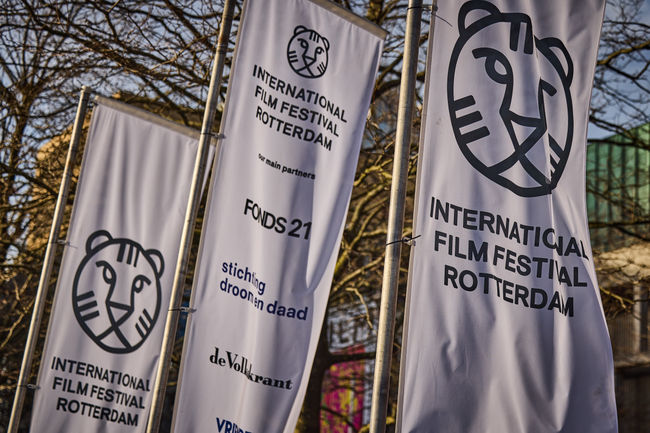
Is it important for you that your film will be screened in competitionat the festival in Rotterdam? Why is this?


Yes it is important. I am an artist so therefore the film is largely seen in the context of a galleries or museums. This is an opportunity for a different audience to see it.The Rotterdam festival is very good at programming experimental films from a wide range of backgrounds. It’s a great opportunity for me to see this. I’ve been before and found it very inspirational .

Could you tell us something about current projects you're working on?

I’m currently at the research stage of a film about the DeLorean car.