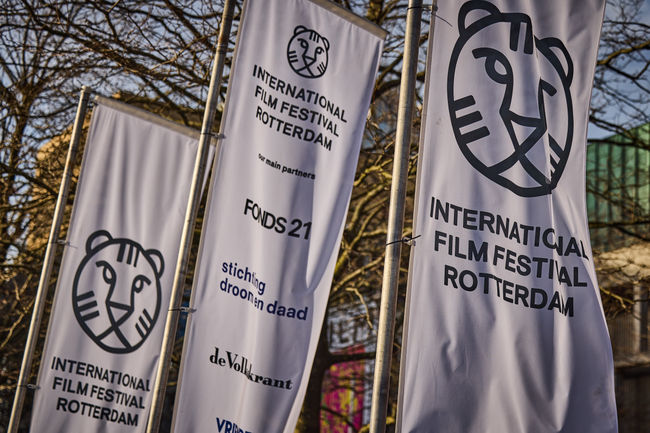
This year, IFFR is screening films on a really big screen: the city of Rotterdam. Passers-by in Rotterdam this week may well be startled by huge images projected high on the front of three office buildings in the city centre. These are three films commissioned specially by the festival for outdoor screening as part of its new Signals: Size Matters programme. Geoffrey Macnab reports.
In Canadian visionary Guy Maddin’s ‘Lectric Chair, Isabelle Rossellini is electrocuted on a wooden electric chair... and seems to enjoy the experience. She looks like an ecstatic silent movie diva as the jolts run through her; in Dutch director Nanouk Leopold’s seven-hour Close-Up (made in collaboration with visual artist Daan Emmen), the minutest expressions on three men's faces are registered in slow motion and on an enormous scale. And in Mexican auteur Carlos Reygadas' Serenghetti, the Rotterdam public gets to spectate at a football match with a difference, played by two amateur women’s teams high in an ancient mountain range in central Mexico.
His film, Maddin explains, was partly inspired by his love of Bessie Smith’s song Send Me To The Electric Chair. “For some reason, I’ve been thinking about electric chairs a lot lately. I just wanted to put Isabella Rossellini in an electric chair and electrocute her. I thought it would be kind of fun.” His film also takes a few sly digs at inventor Thomas Edison, sometimes credited as the inventor of the electric chair. “He was a ruthless capitalist. That reminded me of Hollywood. I thought, all these things are related to one another. Jean-Luc Godard said all you need to make a movie is a girl and a gun. Well, I have a girl and an electric chair!”
Leopold, meanwhile, promises a film that will make viewers feel they too are being watched. “Very small things change. These people had to sit for a very long time. They get tired, or close their eyes for a second. I gave them small assignments, like looking in another way. Every change in what they do makes a narrative.”
Reygadas’ Serenghetti will have a special resonance in a football-crazy city like Rotterdam. The teams accept women of all ages, who have decent personal skills, although the tactics are nil. “They use very fair play,” Reygadas says of the two teams of women footballers, who are watched by a small number of spectators (including a horse). The film underlines its director’s continuing fascination with landscape, his lyricism and his sly surrealism.
The three projects – all silent – are part of Size Matters, a special programme in IFFR’s Signals section, and were produced through London-based Illuminations Films, run by Keith Griffiths and former IFFR director Simon Field. “They all entered into it very enthusiastically,” Field notes of the three directors. He describes his role as producer as “a go-between and an encourager – the necessary link between the festival and the filmmakers.”
Overseeing Size Matters is Rotterdam programmer Edwin Carels. He points out that, while three films on such a grand scale is bound to attract attention, these are only part of a rich and varied programme. “They are the alibi for Size Matters,” Carels says. “I am happy in the shadow of these suns to be doing my programme, which I hope offers some more depth and some more context to their projects.” Carels suggests that, in a period when we are watching moving images on everything from I-Pods to Imax screens, this is a fertile time for exploring how we “consume images”.
Festival director Rutger Wolfson has commented of the Urban Screens section of Size Matters that “filmmakers are used to making films for a very generic space – the screen in the cinema. There are so many screens nowadays in public spaces, but they all contain information or commercials. I thought it would be very interesting to see what filmmakers can bring to these screens.”
Size Matters aims to “infiltrate” all the different types of urban screens in Rotterdam. The films are bound to be seen by a far broader audience than would normally attend avant garde screenings at a film festival. The intention is to take work that might otherwise be in the margins of the festival and to place it where it just can’t be missed.